
Reading the Edges
How to read the corpus by its dependencies
The System Has No Trunk
Most frameworks are trees. This one is something else.
A tree has a trunk, and a reader knows what to do with it. Start at the top, follow a branch down, and each step narrows toward a leaf. Remove a branch and the rest survives. The structure tells you where to begin and which way to travel.
The Realis corpus is a constraint network. Its documents connect through dependencies, where one condition gates another and the failure of an upstream condition changes what a downstream evaluation means. No single document lies beneath all the others the way a trunk supports its branches. A reader who arrives looking for the trunk will come away empty.
The search for a trunk is itself what obscures the structure. While a reader hunts for the thing at the bottom that everything depends on, the dependencies that govern movement stay hidden, because they run from condition to evaluation, across the network, in the direction a failure would travel. The instinct to find a hierarchy is the first thing that sends a reader off course, and it misleads precisely because it looks like the responsible thing to do.
What governs movement through this corpus is the edge: the dependency that connects an upstream condition to a downstream evaluation that relies on it. Reading the corpus means reading its edges. This page is how.
Why Reading the Edges Is the Whole Method
An edge is a dependency with a direction and a type.
When one condition depends on another, the link between them is an edge, and it points from the upstream condition to the downstream evaluation that needs it. Authority depends on formation. Verification depends on trace. A correction landing depends on the pathway staying continuous. Each of those sentences names an edge.
The edge tells a reader what to do, because the same upstream failure can mean two entirely different things downstream depending on the edge type. Knowing which document lies upstream of which gets a reader nowhere on its own. The reader has to know what the upstream failure does to the thing downstream of it, and that is the difference between a result worth inspecting and a result that should never have been produced.
In a network, you navigate by reading what each dependency does when it fails.
The One Question That Selects Everything
At every edge, one question governs the next move.
When an upstream condition fails, ask what the failure did to the downstream object of evaluation. Did it remove the object, or corrupt it? Removal and corruption are two different relationships between an upstream condition and the evaluation that depends on it, and treating them as degrees of the same failure is the error that follows. One takes away the thing the downstream evaluation was supposed to read. The other leaves something to read and makes it the wrong thing. The downstream symptoms differ, the danger differs, and the correct response differs. The whole of traversal reduces to recognizing which one a reader faces.
A third move sits one level up from the edge itself. Sometimes the right reading is that this surface should never be entered at all, because the conditions for correction to land are already gone. That move belongs to selection, and the section below treats it in its own right.
When the Failure Removes the Object: Stop
A validity edge removes the thing the downstream evaluation acts on.
When the upstream condition fails across a validity edge, the downstream evaluation has nothing to work on. No decision state has formed, no signal has arrived, no reference exists. The evaluation either cannot proceed, or proceeds and returns nothing a reader can interpret.
A validity-edge failure announces itself. The evaluation halts, or it returns an absence that a competent reader recognizes as absence rather than as a result. The failure is legible at the moment it occurs.
The corpus instances this where formation fails beneath the Structural Authority Gate. When no formation rule resolves under load, no decision state forms, and the gate has no formed authority to evaluate. The gate may emit a procedural output anyway, but the authority state it was meant to read does not exist. The reading is to halt at the upstream finding. There is no downstream result to inspect, trust, or correct, because the object the downstream evaluation needed was never present.
When the Failure Corrupts the Object: Correct, Then Re-Evaluate
A correctness edge corrupts the object while leaving it in place.
When the upstream condition fails across a correctness edge, the downstream evaluation still has an object to work on. The object is the wrong one, or it contains inputs the system has misidentified. The evaluation proceeds to completion and returns a result that has the form of a valid output and none of its standing.
A correctness-edge failure conceals itself. The output reads as ordinary, and nothing in the result signals that the input was corrupt, because the result is structurally well formed. It passes inspection, because inspection examines the output and the output looks like every other passing output. The corruption emerges later, if it emerges at all, when the result drives a consequence that fails to match the reality it was supposed to describe.
The corpus instances this where authority is upstream of where the record places it. A decision state exists and authority inputs exist, so the gate proceeds, but it proceeds on authority the system has mislabeled, and its return points at the wrong actor. The reading is to correct the upstream input first, then re-run the downstream evaluation, and to treat any result produced before the correction as pointed at the wrong object regardless of how clean it looks.
A correctness edge is the more dangerous of the two, because the validity edge protects itself through visible failure and the correctness edge gives no such warning.
When the Surface Should Not Be Entered: Re-Route
Before reading the edges within a surface, read whether the surface admits entry at all.
A surface admits structural intervention only where reality contact survives, meaning the declared function is still coupled to observable outcomes through a traceable, verifiable, consequentially bound pathway. Where a valid decision state can still form, where verification still binds to consequence, where custody attaches to identifiable actors, and where pathways run continuous, the surface admits entry. Where any of those conditions has failed, the surface is disqualified outright, and no ranking exercise can rescue it.
This is the move that runs against instinct. When an institution fails loudly, the pull is to enter where the failure is loudest, because the stakes read as highest there. Reality contact is distributed on entirely different terms. Institutions in advanced cascade have usually lost reality contact before the failure became loud enough to draw attention. By the time the urgency signal dominates, the conditions for correction to land are already gone, and effort spent there is absorbed without producing correction. Adding information does the same. A surface that has lost the conditions for correction absorbs signal as readily as it absorbs effort, and the reading is identical: re-route.
The selection applies to surfaces. A single institution often spans surfaces at very different levels of reality contact: one reporting function that still binds decisions to evidence, another function within the same walls that has drifted into declarative mode. The reading is to find the surface that still admits entry, which is frequently a quiet one, and to re-route there while the loud surface that no longer passes the gate goes unentered.
The loudest failures are usually disqualified. The viable surfaces are usually quiet.
Where to Start Is the Wrong Question
Readers arrive asking where to begin. In a network, that question has no fixed answer.
In a hierarchy, where to start is settled by the structure: begin at the top. A network has no top, so the entry point depends on where the reader already enters. A safety engineer tends to enter through standards, a lawyer through authority, an educator through memory continuity, an AI researcher through correction capacity. Every one of these is a working door, and none is more central than the others.
What the reader enters on is an edge. Authority depends on conditions that memory continuity preserves, so a reader who enters at authority is one edge away from memory. Correction depends on authority, so a reader who enters at correction is one edge away from both. The doors differ, and the structure reached through any of them is the same, because the dependencies are real and they connect the same way regardless of which one a reader noticed first. This is why the corpus can be entered by concept, and why there is no single reading order to recover. The order is supplied by the edges, once the reader starts reading them.
Equal as doors does not mean equal as dependencies. Some conditions function as gateways through which multiple downstream evaluations must pass, regardless of where the reader entered. Others preserve, transmit, or evaluate conditions established elsewhere. The Structural Authority Gate instances the first kind: a reader who entered through standards and a reader who entered through memory both reach it, because the evaluations downstream of authority all pass through it. Reading the edges reveals these differences, because centrality in a constraint network is expressed through dependency structure, and hierarchical position never enters into it.
Reading the Edges in Order
The three readings compose into a single traversal.
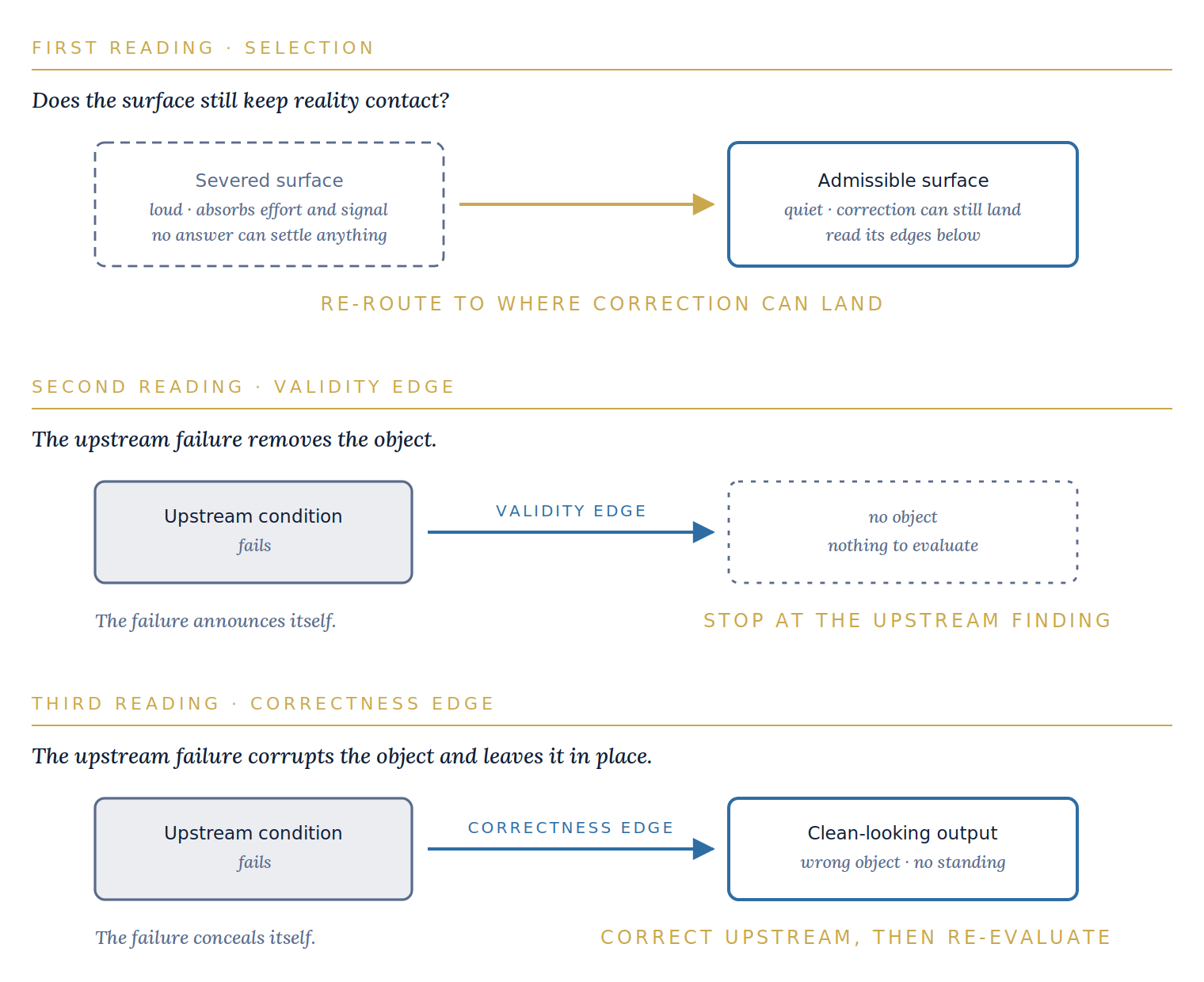
Facing any surface, read the selection question first: does this surface still keep reality contact? If it does not, re-route to one that does. There is no value in reading the internal edges of a surface that cannot be corrected.
On an admissible surface, read each dependency by its edge type. Where an upstream failure removes the downstream object, halt, because no downstream result exists to interpret. Where an upstream failure corrupts the downstream object, correct the upstream input first, then re-evaluate, and discard any result produced before the correction even when it reads as clean.
That is the whole of it. Selection decides whether to enter. Edge type decides what an upstream failure did. The reading is diagnostic throughout. This page names how to read what a reader faces, and it stops there, because what to build once the reading is done belongs to the person inside the outcome, and no reading can make that decision for them. For the practitioner who has finished the reading and found a severed surface, the corpus collects what comes next in one place: WSA-003, After Recognition, sets out the path from recognition through re-route, conduct, preservation, and reconstruction.
For the edge-type distinction stated as a structural object: See DX-DE-001, Dependency Edge Type
For the selection and admissibility logic in full: See RSS-003 and RSS-003-N1, Entry Is Not Where the Fire Is
For the conditions these edges connect: See The Corpus by Concept for the conceptual map of the structural conditions and the documents that establish them.