
Before the Parts, the Whole
The corpus as one structure, before you read it in pieces
Before the Parts, the Whole
The corpus is dense by design, and it grew one observation at a time.
This page does the one thing no single page can do for itself: it shows the structure assembled, so you know which part you are reading when you reach it. It is built as the aircraft's parts catalogue: each element below wears a plate stating its kind and its maker. Read this page for the shape. Read the linked pages for the substance.
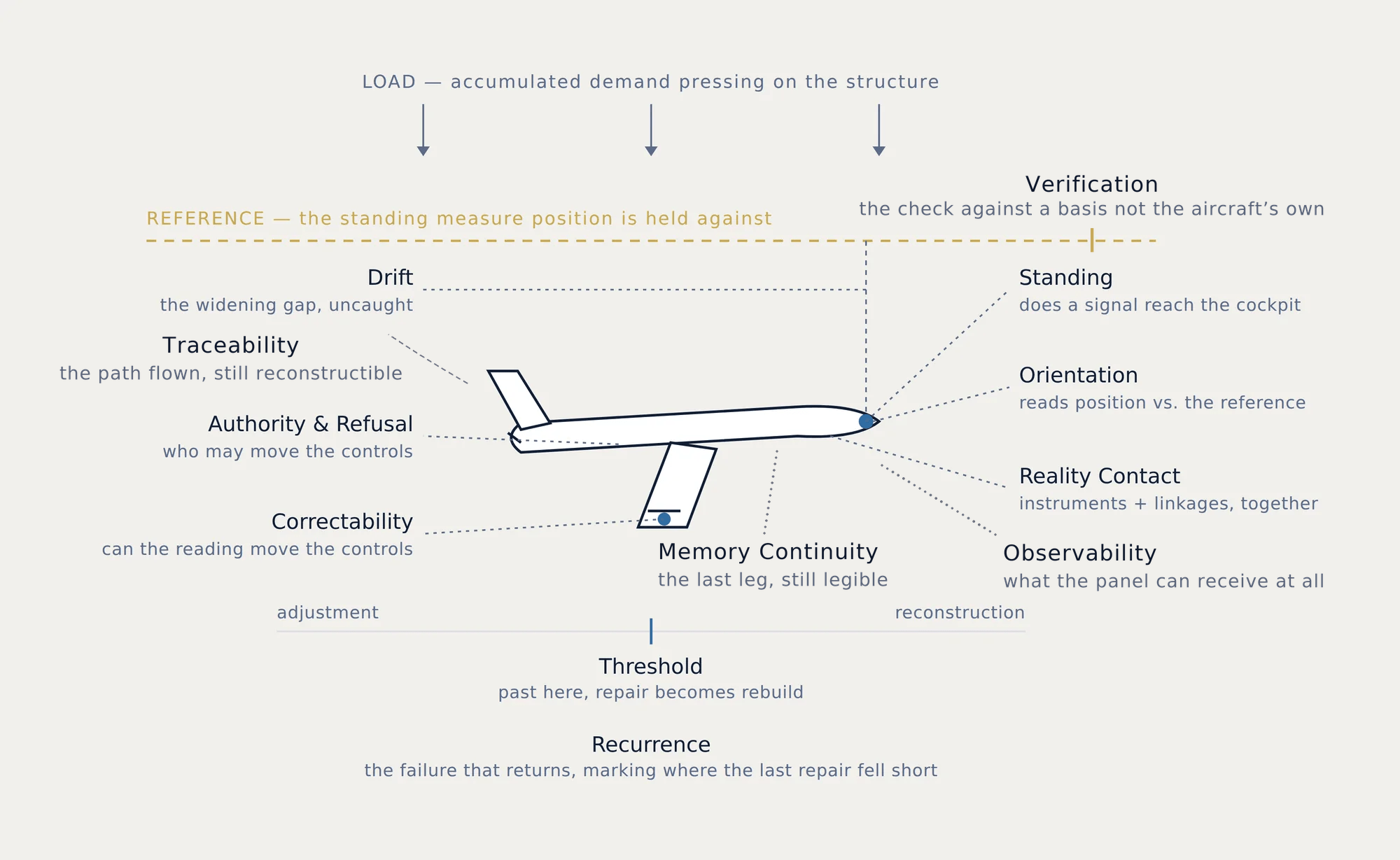
Think of the Corpus This Way
An aircraft holds its position against increasing load.
Every page you are about to read describes one way that effort succeeds, or fails. Some describe individual elements, others the relationships and mechanics among them, or the bodies of work built on the whole. Each page is one view of the same machine, seen from a different angle.
The One Thing the Machine Does
Read reality, and act on it, under load.
An institution, like an aircraft, has a structural job beneath its stated purposes: read where it actually is, and stay able to act on that reading, while demand accumulates against it. When it can do both, it answers to reality. When it loses either one, it begins to fly on a reading of the world that is no longer true, and it flies that way, smoothly, until consequence arrives without warning.
A system can be running well and have already lost the capacity to be corrected. Seeing that distance early is what the corpus was built for.
The Parts Catalogue
Most of the parts below have their own page. Read the plain idea here; follow the link when you want the depth. Each plate reads kind, then maker.
Parts Catalogue · Element · Kind · Provenance · Mission Role
Reality Contact
Umbrella property · Machined here
The aircraft first has to know where it is, and then the controls have to respond to what it knows. Reality Contact is the property that requires both, and almost everything in the corpus is about one of its two components or the other. It is the property the whole machine protects, never itself a component.
Orientation
Capacity at the Reality Contact layer; relational structural state at the substrate · Machined here
Knowing where the aircraft is: present position read against a fixed reference as conditions change. The instruments can read true, or they can read stale.
Correctability
Capacity · Machined here
A reading is not enough on its own; it has to reach the controls and change the system's course. An aircraft can see the terrain perfectly and have a jammed control run, and that is the more dangerous failure, because the instruments still look right.
Drift
Invariant mechanic · Machined here
What the system believes and what is actually true slowly separate, unnoticed by the system itself. It is what the instruments are supposed to catch and, under load, increasingly do not.
Memory Continuity
Condition · Machined in part
What the aircraft still knows from the last leg: the relevant prior state survives with its relational tissue intact, so the present reading can be checked against how it got here. Retention alone is a different function.
Supplier note: the relational preservation machinery comes from archival science; the element's seat in the corrective problem is house work.
Standing
Condition · Machined here
The condition under which a signal can enter the system's corrective architecture in a form that architecture can receive. The condition can be real, even observable, broadcast in the clear; the aircraft was never fitted with a receiver for it.
Related research: What Keeps a Record Standing →
Authority and Refusal
Condition · Machined here
Who is able to act on a reading, and when an input must be refused because its basis cannot be produced. Authority connected to evidence and consequence is where an admitted reading can become a correction.
Load
Substrate variable · Machined here
The stress the structure has already absorbed. It degrades every other part at once, slowly.
Threshold
Invariant mechanic · Machined here
The point where fixing it stops being an adjustment and becomes a rebuild. A threshold sounds no alarm and is recognized only after it is crossed.
Recurrence
Invariant mechanic · Evidential test · Machined here
The same failure comes back after a system has studied it. It marks where the last repair failed to reach, or failed to persist: the machine's error signal about its own past corrections.
Supplied Flight Systems · fitted to this airframe
Observability
Property · Supplied by control theory
Whether a system's internal state can be inferred from what it puts out. The instruments can only fly the aircraft they can read, and a condition the panel cannot represent is a condition the flight never receives.
House application: the observability boundary, the limit of what a corrective architecture's instruments and language can receive, stated in SOT-WP-010.
Verification
Operation · Supplied by metrology, systems engineering, audit and EBM, open science, legal practice
Externally grounded checking: comparing a claim, record, or reading against a basis other than the system's own account. It is how the aircraft learns anything it cannot learn from itself.
House application: the legal tradition's consequence-relative independence predicate applied to the verified-record definition in the record-standing program.
Traceability
Condition · Supplied by metrology, archival science, data provenance, configuration management, legal practice
The crossing from evidence to decision to consequence stays reconstructible where later correction depends on knowing what an earlier correction reached.
House application: the condition applied to the forms of corrective capacity that depend on reconstructing the corrective history.
The Substrate
Substrate variables · Machined here
Beneath the elements above sit the variables the science models: the Decision System doing the flying, the Invariant Conditions that must stay true for correction to stay possible, and Structural Failure, the form collapse takes when they do not. The theory works at this depth; the pages above are its cockpit view.
Force / Operative Status, whether a published criterion is operative, is under active study in Making Standards Matter →
How the Parts Connect
Each page describes the same structure from a different angle.
The connections between them are where most of the understanding lives. Orientation and Correctability are the two components Reality Contact requires, and either can fail while the other still works. Drift is what happens to Orientation when the reference stops being checked. Standing is the condition under which a good reading can enter the corrective architecture in time for Authority to act on it. Memory Continuity is what lets the present reading answer to the flight that produced it. Load degrades all of these at once, slowly, until a Threshold turns a cheap fix into an expensive rebuild. And Recurrence is the record the machine leaves when that degradation was never reached by the last repair.
The corpus asks whether a contradiction can become observable, acquire standing where required, survive in records where correction depends on history, reach authority, and arrive before the threshold. Said in one line, which only the pages together support: reality has to be read, the reading has to reach whoever can act, and the acting has to happen before the load makes fixing it far more costly than catching it early.
The research weight of the corpus presently sits on Correctability. Orientation supplies the reference a correction needs; Correctability is where that reference meets structure, and structure is where the constraints collect: each of the conditions the corpus asks about can fail independently of the truth of the underlying reading. That is a statement about where the constraint problem is thickest, not about the architecture.
The Bodies of Work, and What Each One Does
One machine; several kinds of work on it.
Every part above belongs to the same machine, and the corpus divides the work on it by job.
Establishes
Structural Orientation Theory →
What has to stay structurally true for the machine to keep contact with reality at all.
Tests
The theory's claims, against documented cases drawn from the public record.
Describes
What sustained load does to the parts, and how failure moves through them.
Supplies
The methods and standards for preserving or restoring the capacity for correction.
Governs
Upstream of the layers rather than one of them: why correction is undertaken and what must be protected while correcting.
All of it is developed and tested at one laboratory: Realis Institute →
Where the Parts Come From
A specialty aircraft, and a specific mission.
The aircraft above is not a general-purpose machine. It is a specialty aircraft, assembled around a single question: under what conditions reality retains the ability to correct a complex human system. The mission selects every part.
Most of the parts come from other shops, and that is what makes the aircraft possible. Safety engineering, archival science, decision science, control theory, the philosophy of science, and other mature traditions have spent generations testing components this corpus needs: feedback, falsification, audit, records, investigation, learning from failure. The site names each supplier where its work borders the corpus's own, and rebuilding that work badly here would only make the aircraft worse.
And some parts are machined here because the search, so far, has found their equivalent in nobody else's catalog: the property the whole machine protects, defined so it can be tested; the conditions question itself, taken as the object of a laboratory; the instruments and standards that check for the property one institution at a time; and the research programs that state, in advance and in public, the results under which the shop's own taxonomies would be wrong. House markings are provisional wherever the visiting is unfinished: a supplier may yet be found for any of them, and the plate will be restamped if one is. That is what the house catalog contains, and all of it is open: every part can be inspected, used, and tried against the world through Publications.
A brilliant part certifies nothing about the machine around it. The catalogue above stamps every plate with its maker precisely so the claim stays inspectable: what was bought, what was machined, and what the assembly is answerable to. Open the cowling.
Where to Go Next
Three doors, by what you need.
To know what the discipline is and what separates it from adjacent fields, start with Institutional Physics. To meet the property the whole machine protects, read Reality Contact. To watch the whole logic resolve through thirteen documented failures, read Recurrence and Correction.
Once you can see the whole: Where to Begin Reading takes you into it, through eight essays: four on the mechanics, four on documented failures.
Read them in any order you like. You needed the whole first, and now you have it.
Banner: an airliner landing at a commercial airport. The aircraft can be flawless and still have nowhere to arrive: the runway, the tower, the approach lights, and the agreement of a city to build and keep all of it had to exist first. What it takes for an airport like that to exist is the question underneath this catalogue.
Related materials: Reality Contact · Structural Orientation Theory · Institutional Physics · Recurrence and Correction · Field Vocabulary